

View User Security
Review security configurations, including data security, content packages, and capabilities, from a single consolidated view.
Access requirements
Custom profiles with one of the following capability sets:
- Security (Read, Simple) and User Management (Read, Simple)
- Permission Management (Read, Simple) and User Management (Read, Simple)
Reach out to your administrator for access.
Overview
Visier uses a permission-based security model. Users receive access through permissions assigned directly to their account or inherited through user groups. The Users and User Groups rooms provide visibility into how security is structured and simplify how you review access. From either room, you can drill down to inspect assigned permissions, including the data security, content packages, and analytic capabilities they grant. This makes it easy to audit, troubleshoot, and evaluate access models without switching contexts.
Use the
-
What is granting a user access to a specific metric?
-
Does the user have access to perform specific actions in Studio or the solution experience?
-
What access do members of this user group get?
-
Which users are affected if I change this user group’s permissions?
Caution:
View user access details
-
To access the Users room, do one of the following:
-
In the Global Workspace, on the navigation bar, click Tenant > Users.
-
-
In a project, on the navigation bar, click Security > Users.
-
Select a user in the Users list.
-
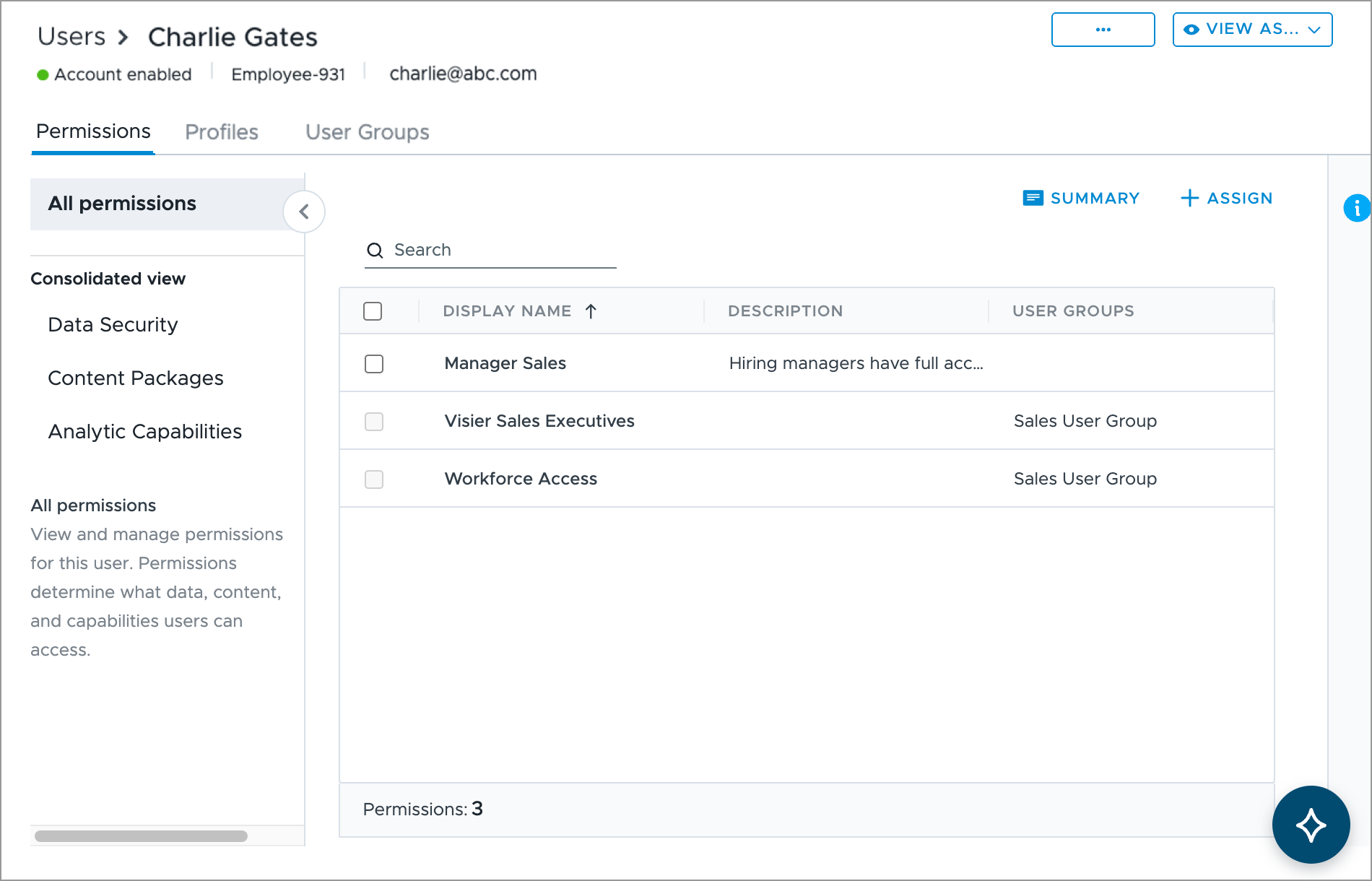
Select from the following tabs to review access details:
-
Permissions: Lists all permissions assigned to the user, whether assigned directly or inherited through a user group. Explore a consolidated view of the following:
-
Data Security: The data objects a user can access across assigned permissions, such as analytic objects, and if enabled, sources, data categories, and targets.
-
Content Packages: All content available to the user, such as metrics, dimensions, analyses, and key groups, and indicates the content package and permission that granted it.
-
Analytic Capabilities: The specific capabilities the user has to perform actions in the solution experience.
Tip: Click on an item in Data Security or Content Packages to see more details in the Permissions detail panel, such as content visibility, data access, and population access. For more information, see View additional access details.
-
-
-
User Groups: Lists the user groups the user is assigned to.
-
-
Click Users in the upper-left of the page to return to the Users list.
View user group access details
-
In a project, on the navigation bar, click Security > User Groups.
-
Select a user group in the User Groups list.
-
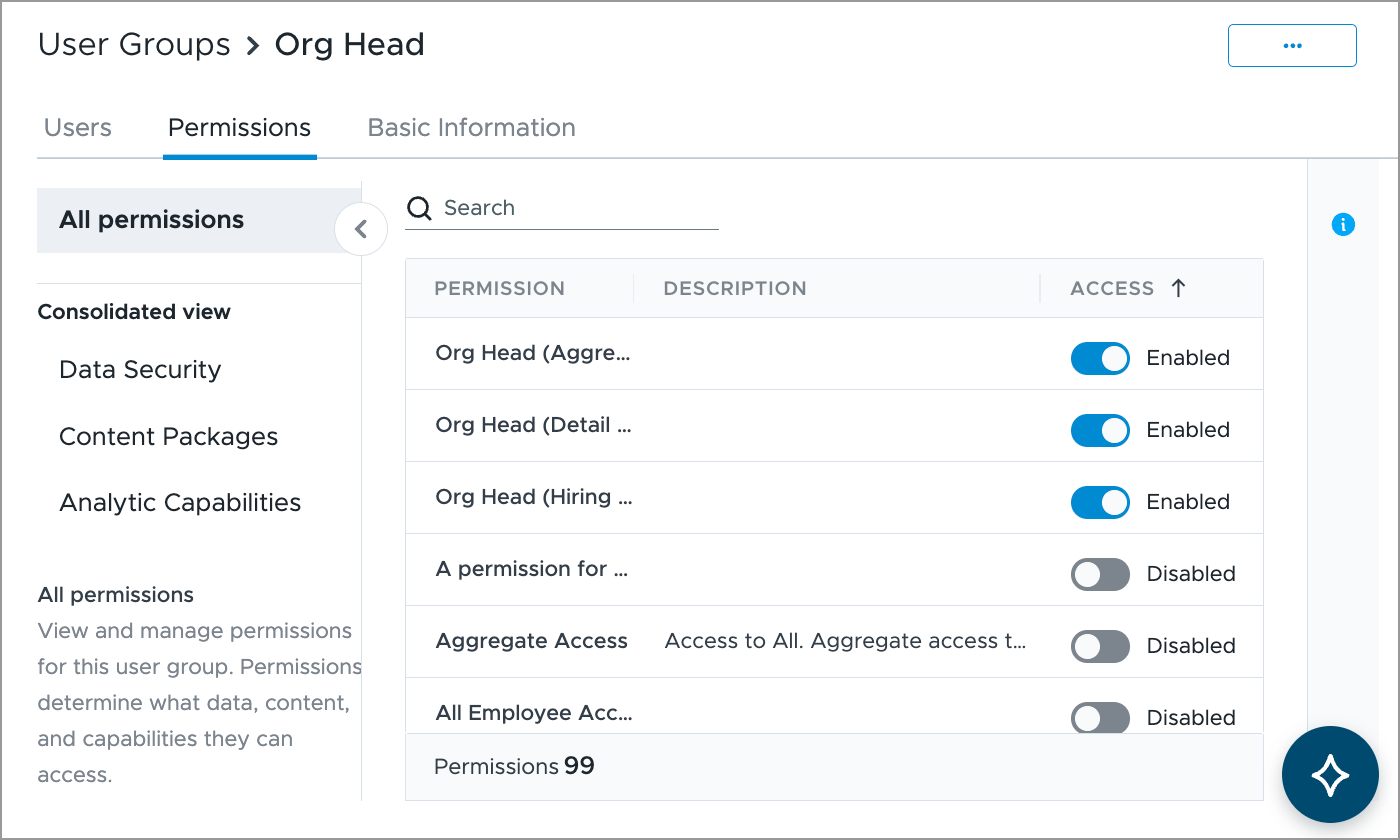
Select from the following tabs to review access details:
-
Users: Lists the users who are members of the user group.
-
Permissions: Lists all permissions assigned to the user group. Explore a consolidated view of the data security, content packages, and analytic capabilities those permissions grant.
Tip: Click on an item in Data Security or Content Packages to see more details in the Permission details panel, such as content visibility, data access, and population access. For more information, see View additional access details.
-
View additional access details
When viewing permissions for a user
Data Security
-
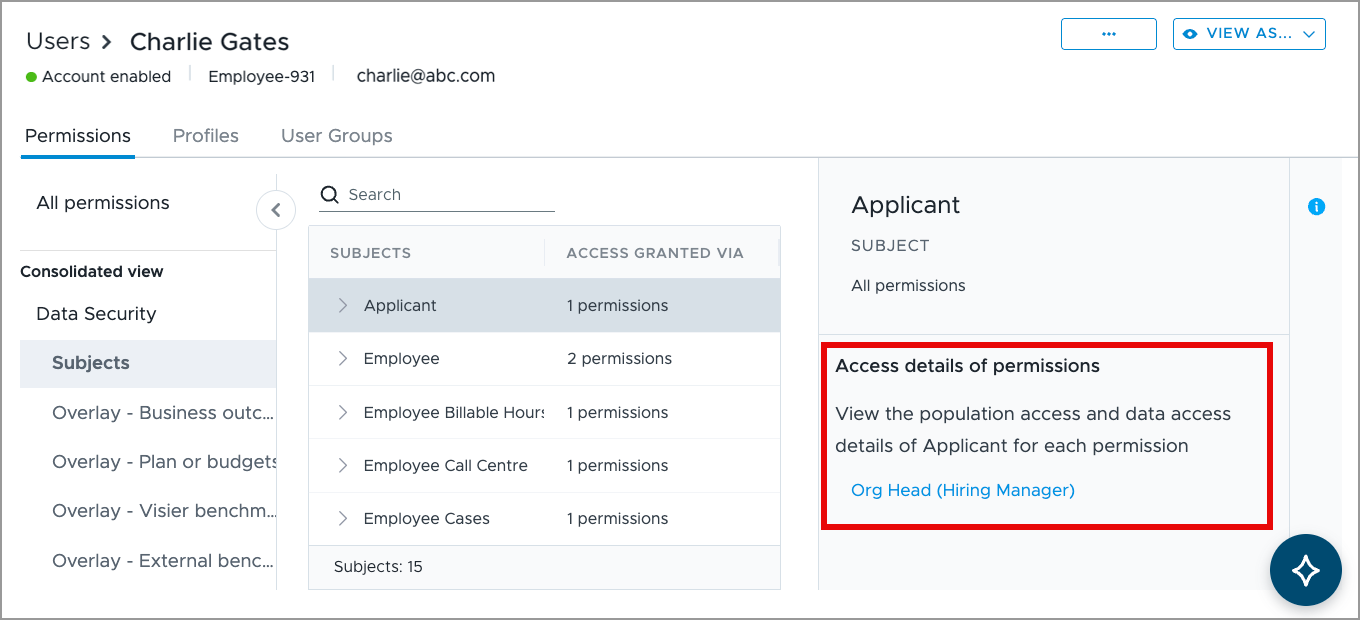
In the Permissions tab, under Consolidated view, click Data Security and then click on an object type, for example Subjects.
-
In the subjects list, choose how to view details:
-
Click the Expand button next to the subject to view the assigned permissions that grant access, along with a quick summary of its population and data access.
-
Click a subject, such as Applicant to open the Permissions detail panel.
-
-
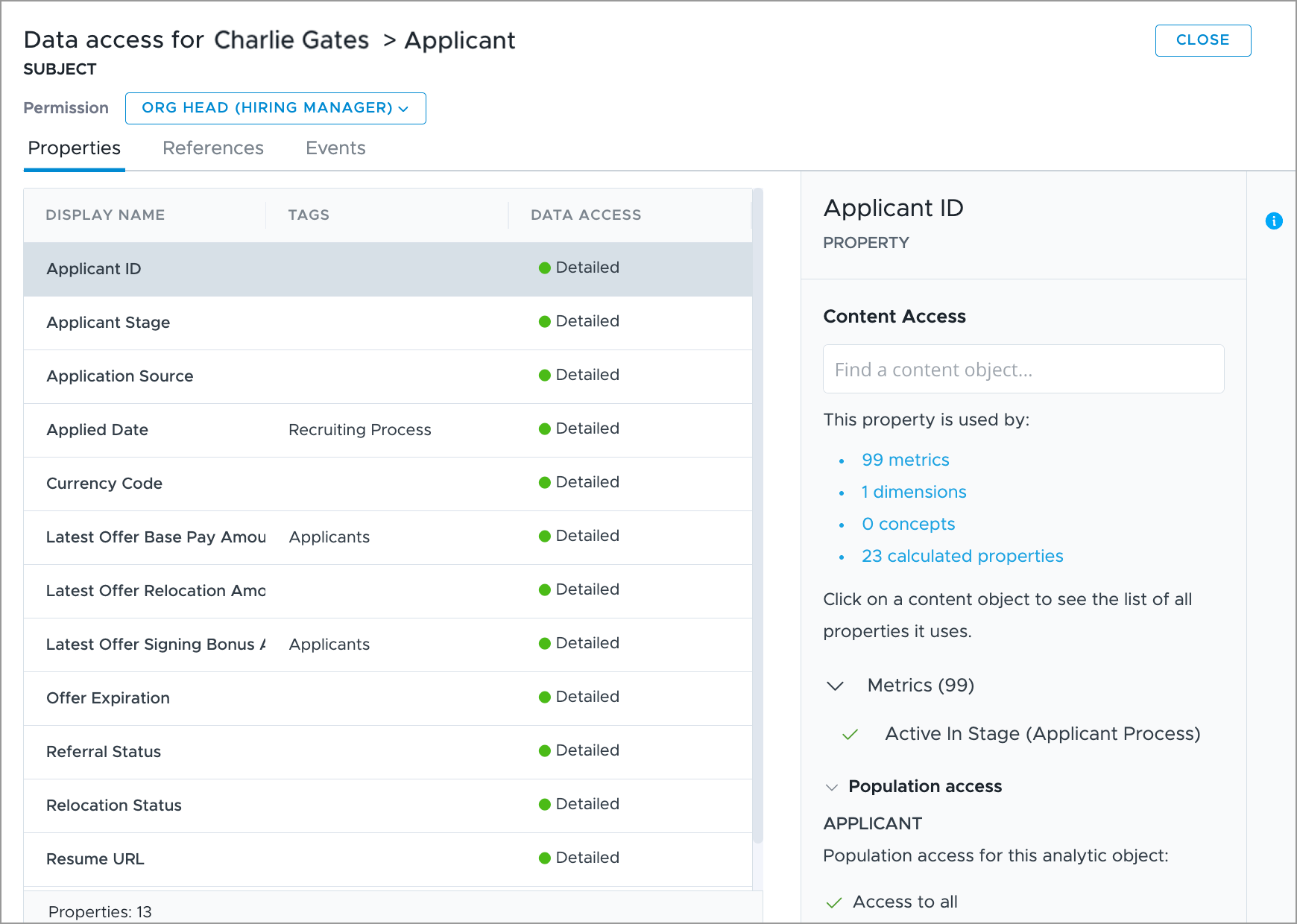
In the Permissions detail panel, under Access details of permissions, select an assigned permission to view a list of all accessible properties, references, events, and related objects.
-
In the Properties list, select a specific property, such as Applicant ID, to view its population access and content access details, including the exact metrics, dimensions, concepts, and calculated properties that use it.
Tip: Use the Permission dropdown menu in the upper-left of the page to navigate between assigned permissions.
Content Packages
-
In the Permissions tab, under Consolidated view, click Content Packages, and then click on a content type, for example Metrics.
-
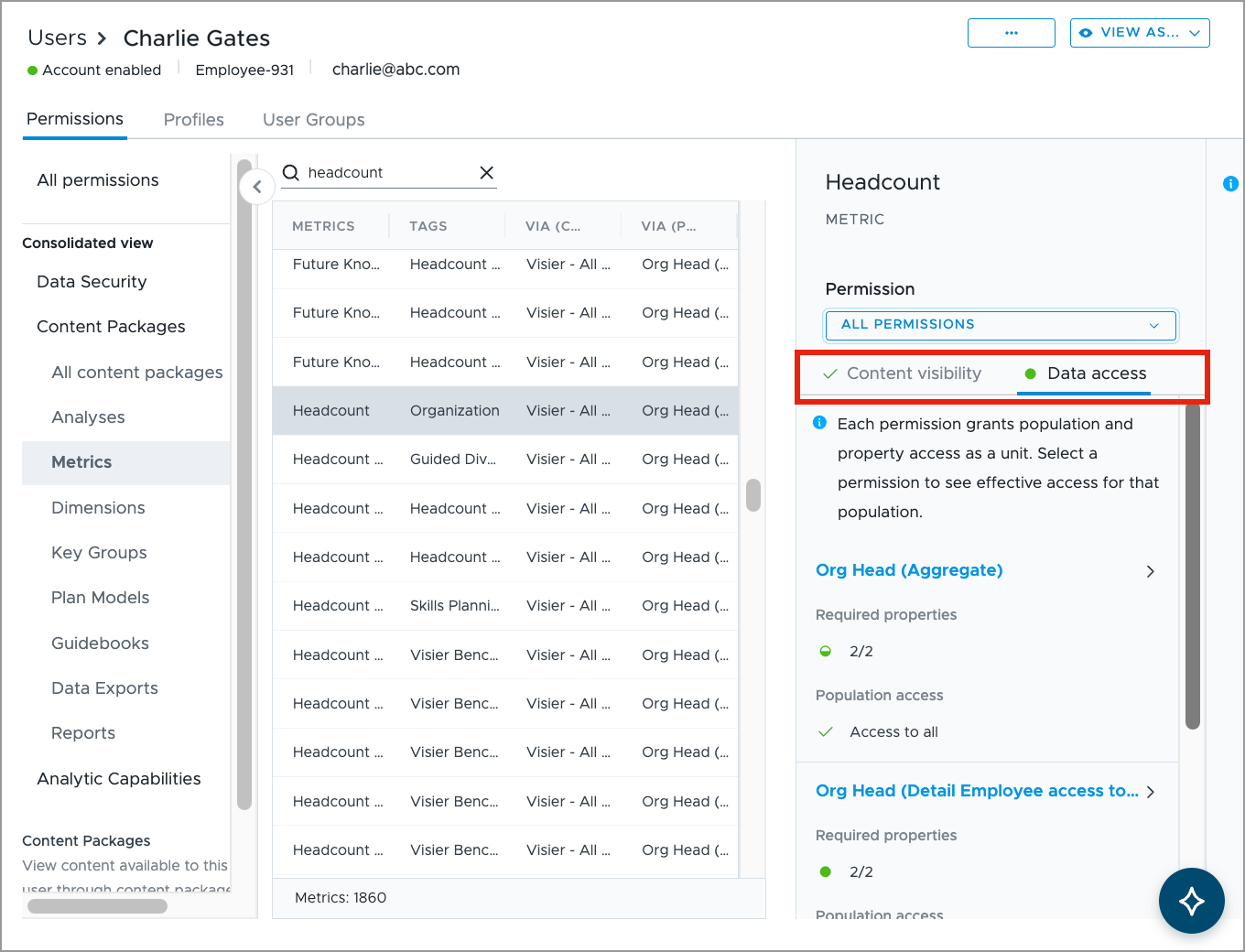
Find and click a metric, such as Headcount, to open the Permissions details panel.
-
In the Permissions detail panel, use the Permission dropdown menu to view the content visibility or data access summary for a specific permission.
-
Select a tab to review details:
-
Content visibility: Displays which permission or content package granted access.
-
Data access: Displays the access levels for all required properties and the population access.
Tip: Hover over items in the Permissions details panel to view granular access details.
-
Next steps
As a final check, preview the user's access in the solution to confirm their security configuration is generating the expected behavior. For more information, see Preview the Solution as a User.
Depending on the outcome, you may need to modify access:
- To review a permission’s configuration and assignments, see Review Permission Details.
- To update a user group's permissions, see Set the User Group Permissions.
- To adjust the members in a user group, see Manage the User Group Membership.
- To update a user’s permissions, see Assign Permissions to a User.
- To manage the profiles assigned to a user, see Manage the profiles assigned to a user.