
Vee in Microsoft Teams
Ask Vee questions about your workforce in Microsoft Teams.
Vee gives you direct access to your organization's people data through a simple conversational interface. This way of interacting with Visier People is designed to help you quickly find answers to your business questions without having to build your own visualizations and conducting your own analysis.
Prerequisites
-
Vee's functionality varies based on your organization’s specific configuration. Before asking Vee a question, ensure you've identified which Vee experience you have. For more information, see Determine your Vee experience.
-
Your administrator must enable the integration and add the Vee by Visier app before you can start a conversation with Vee in Microsoft Teams. If you don't have access to Vee by Visier in Microsoft Teams, contact your administrator. For instructions on how to enable the integration, see Set Up Vee in Microsoft Teams.
Ask Vee 2.0 a question
- To start a conversation in Microsoft Teams, start a new chat, and type Vee by Visier in the To field.
- Type sign in to bring up the Welcome to Vee message and click Click to sign in.
Result: The Sign in page opens in a new browser tab.
- In the Sign in page, enter the vanity name in your Visier URL and click Continue. For example, if your Visier URL is jupiter.visier.com, your tenant vanity name is jupiter.
- Sign in using your Visier username and password or single sign-on credentials.
Result: If successful, you will receive the You are now signed in message. Close the tab and go back to Microsoft Teams.
Note: The default session timeout is 60 days.
-
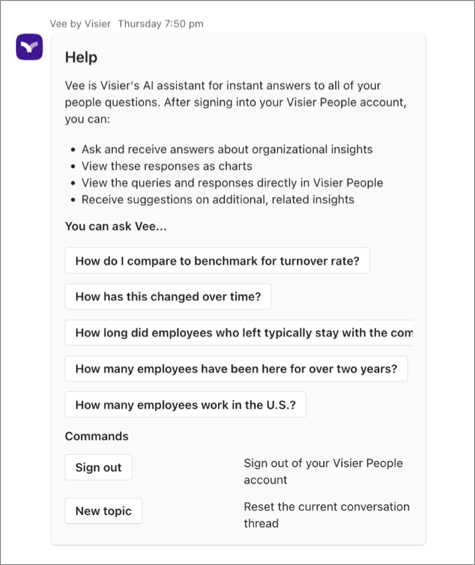
In the Vee by Visier chat, enter a question in plain language or type help to bring up the Getting Started message which contains pre-built questions to start your conversation.
-
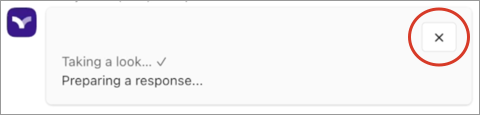
While Vee processes your question, progress messages display real-time updates. If you'd rather ask something else before Vee finishes, you can dismiss the progress message and submit a new question.
-
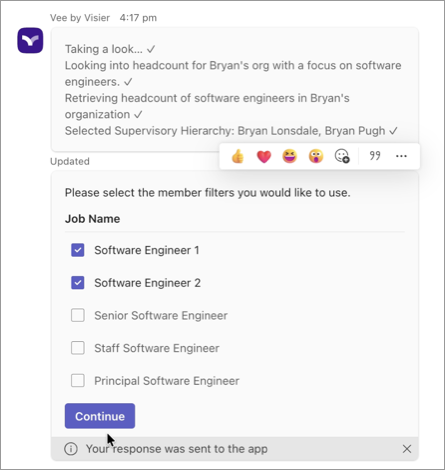
If Vee needs clarification on an ambiguous term in your question, for example How many SWEs do we have? it will ask you to select the members you intended directly in the chat. This helps Vee understand exactly what you're looking for before it provides a response.
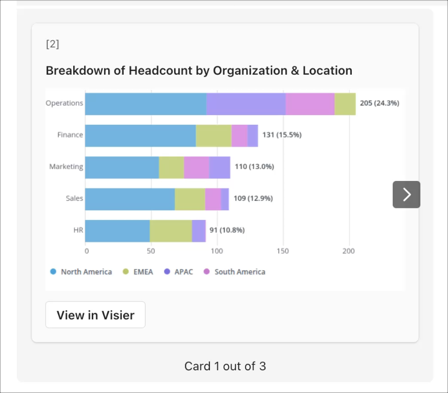
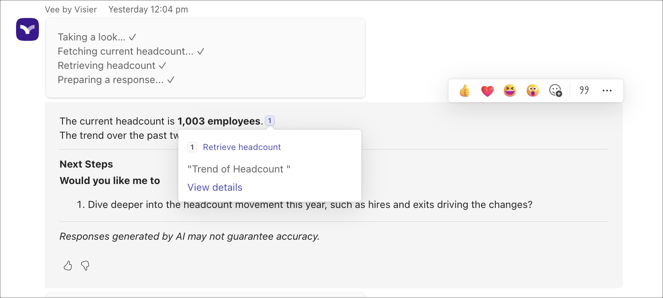
- Review the answer and view the visualization that is generated. Each insight is supported by citations that reference the underlying data source. Click View in Visier to see the visualization in the Explore room of the solution experience. Visuals can appear in the following ways:
At the end of a response: The number on a visual matches its citation number in the response text. If Vee generates multiple visuals, they appear together in a carousel, you can click the arrows to move between visuals, and click a visual to expand and download it. A Card X out of X label at the bottom of the carousel shows the total number of visuals and which one you're currently viewing.
In view details: Hover over a citation and select View details to preview the corresponding visual, or click the citation link to see the visualization or definition in the Explore room of the solution experience. For visual citations, the preview also includes an Open in browser option to view the visualization in Visier.
-
After providing an answer, Vee will prompt you with follow-up actions directly in the chat. You can type the number of the option you want to continue the conversation with or move on to the next step.
-
Ask a follow-up question. Vee retains your current chat history, so you don't need to worry about retyping the whole question from scratch. You can ask multiple questions to delve deeper into a single inquiry.
- Drill down further by entering another question or selecting one of the suggestions. For example: What about last month?
- If the response isn't quite what you are looking for, you can adjust the result by suggesting changes and edits. Vee will refine its response based on the additional information. For example: Group by Organization or I meant Jason K
- Provide feedback to the generated response by clicking the Like button
 or Dislike button
  .
. -
To start a new conversation, type reset.
Note: If a conversation runs long, Vee will prompt you to click New topic to reset the conversation.
- To sign out of your Visier People Account, type signout.
Ask Vee a question
- To start a conversation in Microsoft Teams, start a new chat, and type Vee by Visier in the To field.
- Type sign in to bring up the Welcome to Vee message and click Click to sign in.
Result: The Sign in page opens in a new browser tab.
- In the Sign in page, enter the vanity name in your Visier URL and click Continue. For example, if your Visier URL is jupiter.visier.com, your tenant vanity name is jupiter.
- Sign in using your Visier username and password or single sign-on credentials.
Result: If successful, you will receive the You are now signed in message. Close the tab and go back to Microsoft Teams.
Note: The default session timeout is 60 days.
-
In the Vee by Visier chat, enter a question in plain language or type help to bring up the Getting Started message which contains pre-built questions to start your conversation.
- Review the answer and view the visualization that is generated. Click View in Visier to see the visualization in the Explore room of the solution experience.
-
Ask a follow-up question. Vee retains your current chat history, so you don't need to worry about retyping the whole question from scratch. You can ask multiple questions to delve deeper into a single inquiry.
- Drill down further by entering another question or selecting one of the suggestions. For example: What about last month?
- If the response isn't quite what you are looking for, you can adjust the result by suggesting changes and edits. Vee will refine its response based on the additional information. For example: Group by Organization or I meant Jason K
- Provide feedback to the generated response by clicking the Like button or Dislike button .
- To start a new conversation, type reset.
- To sign out of your Visier People Account, type signout.
For some ideas on how to make the most out of your conversations, see Vee Sample Questions.